- Approval Id
- 02d508a0c5cf3353
- Drug Name
- Apo-Gabapentin 400mg Capsules
- Product Name
- Apo-Gabapentin 400mg Capsules
- Approval Number
- SIN13548P
- Approval Date
- 2008-09-03
- Registrant
- PHARMAFORTE SINGAPORE PTE LTD
- Licence Holder
- PHARMAFORTE SINGAPORE PTE LTD
- Drug Type
- Therapeutic
- Forensic Classification
- Prescription Only
- Dosage Form
- CAPSULE
- Dosage
- **DOSAGE AND ADMINISTRATION**
APO-GABAPENTIN (gabapentin) is given orally with or without food.
When in the judgement of the clinician there is a need for dose reduction, discontinuation or substitution with an alternative medication, this should be done gradually over a minimum of one week.
**Epilepsy:**
_Adults and Pediatric Patients Over 12 Years of Age_
In clinical trials, the effective dosing range was 900 to 1800mg/day. Therapy may be initiated by administering 300mg three times a day (TID) on Day 1, or by titrating the dose as described in Table 3. Thereafter, the dose can be increased in three equally divided doses up to a maximum dose of 1800mg/day. Dosages up to 2400mg/day have been well tolerated in long-term open-label clinical studies. Doses up to 3600mg/day have been administered to a small number of patients for a relatively short duration, and have been well tolerated. The maximum time between doses in the three times a day (TID) schedule should not exceed 12 hours to prevent breakthrough convulsions.

_Pediatric patients age 3–12 years_
The starting dose should range from 10 to 15 mg/kg/day given in equally divided doses (three times a day), and the effective dose reached by upward titration over a period of approximately 3 days. The effective dose of gabapentin in pediatric patients age 5 years and older is 25 to 35 mg/kg/day given in equally divided doses (3 times a day). The effective dose in pediatric patients aged 3 to less than 5 years is 40mg/kg/day given in equally divided doses (3 times a day). Dosages up to 50mg/kg/day have been well tolerated in a long-term clinical study. The maximum time interval between doses should not exceed 12 hours.
It is not necessary to monitor gabapentin plasma concentrations to optimize gabapentin therapy. Further, because there are no significant pharmacokinetics interactions among gabapentin and other commonly used antiepileptic drugs, the addition of gabapentin does not alter the plasma levels of these drugs appreciably.
If gabapentin is discontinued and/or an alternate anticonvulsant medication is added to the therapy, this should be done gradually over a minimum of one week.
_Dosage adjustment in impaired renal function for patients with epilepsy_
Dosage adjustment in patients with compromised renal function or undergoing hemodialysis is recommended in table 4.
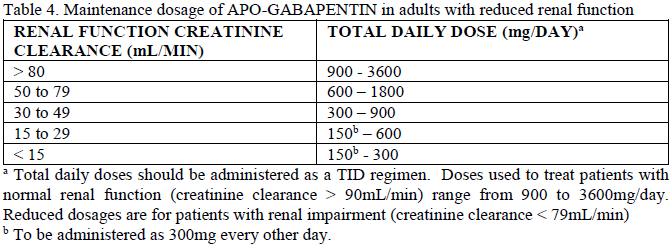
Pediatric patients with renal insufficiency have not been studied.
_Dosage adjustment in patients undergoing hemodialysis_
For patients undergoing hemodialysis who have never received gabapentin, a loading dose of 300 to 400mg is recommended, then 200 to 300mg of gabapentin following each 4 hours of hemodialysis.
- Route Of Administration
- ORAL
- Indication Info
- **INDICATIONS AND CLINICAL USE**
APO-GABAPENTIN (gabapentin) is indicated as adjunctive therapy for the management of patients with epilepsy who are not satisfactorily controlled by conventional therapy.
- Contraindications
- **CONTRAINDICATIONS**
APO-GABAPENTIN (gabapentin) is contraindicated in patients who have demonstrated hypersensitivity to the drug or to any of the components of the formulation.
- Atc Code
- N03AX12
- Atc Item Name
- xn 03 ax 12
- Pharma Manufacturer Name
- PHARMAFORTE SINGAPORE PTE LTD
- Company Detail Path
- /organization/pharmaforte-singapore-pte-ltd

