- Approval Id
- 930f0a66f5ed8ff7
- Drug Name
- KLACID GRANULES FOR ORAL SUSPENSION 250 mg/5 ml
- Product Name
- KLACID GRANULES FOR ORAL SUSPENSION 250 mg/5 ml
- Approval Number
- SIN11387P
- Approval Date
- 2000-09-01
- Registrant
- ABBOTT LABORATORIES (SINGAPORE ) PRIVATE LIMITED
- Licence Holder
- ABBOTT LABORATORIES (SINGAPORE) PRIVATE LIMITED
- Drug Type
- Therapeutic
- Forensic Classification
- Prescription Only
- Dosage Form
- GRANULE, FOR SUSPENSION
- Dosage
- **4.2 Posology and method of administration**
**DOSAGE AND ADMINISTRATION**
**Pediatric Patients 6 months to 12 years of age**
Clinical trials have been conducted using Klacid® pediatric suspension in children 6 months to 12 years of age. Therefore, children 6 months to 12 years of age should use Klacid® pediatric suspension (granules for oral suspension).
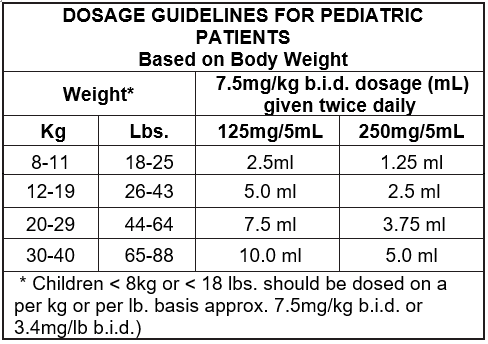
The recommended daily dosage of Klacid® Pediatric Suspension (125mg/5mL or 250mg/5mL) in children is 7.5mg/ kg b.i.d. up to a maximum dose of 500mg b.i.d. for non-mycobacterial infections. The usual duration of treatment is for five to ten days depending on the pathogen involved and the severity of the condition. The prepared suspension can be taken with or without meals, and can be taken with milk.
The following table is a suggested guide for determining dosage:
_**Dosage in Patients with Mycobacterial Infections**_
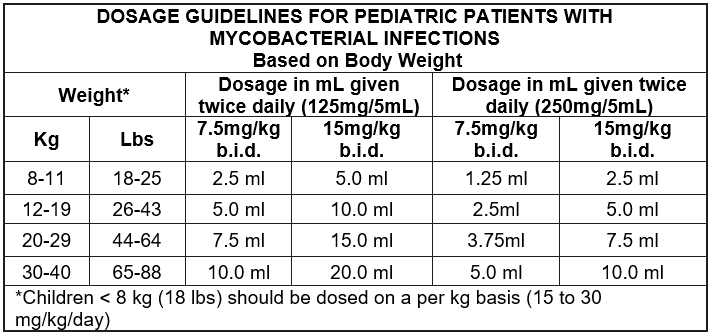
In children with disseminated or localized mycobacterial infections ( _M. avium, M. intracellulare, M. chelonae, M. fortuitum, M. kansasii_), the recommended dose is 15 to 30mg/kg clarithromycin b.i.d. not exceeding a maximum dose of 500 mg b.i.d.
Treatment with clarithromycin should continue as long as clinical benefit is demonstrated. The addition of other antimycobacterial agents may be of benefit.
_**Preparations for use**_
See **section 6.6** – _please refer to the Product Insert/Patient Information Leaflet published on HSA for the full drug information_
_Renal Impairment_
In children with creatinine clearance less than 30 ml/min/1.73m2, the dosage of clarithromycin should be reduced by one half, i.e. up to 250mg once daily, or 250mg twice daily in more severe infections. Dosage should not be continued beyond 14 days in these patients.
- Route Of Administration
- ORAL
- Indication Info
- **4.1 Therapeutic Indications**
Klacid® Pediatric Suspension is indicated for treatment of infections due to susceptible organisms in children 6 months to 12 years, in the following conditions:
1. Upper respiratory infections (e.g., streptococcal pharyngitis).
2. Lower respiratory infections (e.g., bronchitis, pneumonia) (see **section 4.4 and 5.1** regarding Sensitivity Testing – _please refer to the Product Insert/Patient Information Leaflet published on HSA for the full drug information_)
3. Acute otitis media.
4. Skin and skin structure infections (e.g., impetigo, folliculitis, cellulitis, abscesses) (see **section 4.4 and 5.1** regarding Sensitivity Testing – _please refer to the Product Insert/Patient Information Leaflet published on HSA for the full drug information_)
5. Disseminated or localized mycobacterial infections due to _Mycobacterium avium_ or _Mycobacterium intracellulare_. Localized infections due to _Mycobacterium chelonae_, _Mycobacterium fortuitum_, or _Mycobacterium kansasii_.
Consideration should be given to national official guidance on the appropriate use of antibacterial agents.
- Contraindications
- **4.3. Contraindications**
- Hypersensitivity to macrolide antibiotic drugs or any of its excipients (see **section 6.1** – _please refer to the Product Insert/Patient Information Leaflet published on HSA for the full drug information_).
- Concomitant administration of clarithromycin and any of the following drugs is contraindicated: astemizole, cisapride, pimozide, terfenadine as this may result in QT prolongation and cardiac arrhythmias including ventricular tachycardia, ventricular fibrillation, and _torsades de pointes_ (see **section 4.5** – _please refer to the Product Insert/Patient Information Leaflet published on HSA for the full drug information_).
- Concomitant administration of clarithromycin and ergot alkaloids (e.g., ergotamine or dihydroergotamine) is contraindicated, as this may result in ergot toxicity (see **section 4.5** – _please refer to the Product Insert/Patient Information Leaflet published on HSA for the full drug information_).
- Concomitant administration of clarithromycin and oral midazolam is contraindicated (see **section 4.5** – _please refer to the Product Insert/Patient Information Leaflet published on HSA for the full drug information_).
- Clarithromycin should not be given to patients with history of QT prolongation (congenital or documented acquired QT prolongation) or ventricular cardiac arrhythmia, including _torsades de pointes_ (see **sections 4.4 and 4.5** – _please refer to the Product Insert/Patient Information Leaflet published on HSA for the full drug information_).
- Clarithromycin should not be given to patients with electrolyte disturbances (hypokalemia or hypomagnesaemia, due to the risk of prolongation of the QT-interval).
- Clarithromycin should not be used in patients who suffer from severe hepatic failure in combination with renal impairment.
- Clarithromycin should not be used concomitantly with HMG-CoA reductase inhibitors (statins) that are extensively metabolized by CYP3A4 (lovastatin or simvastatin), due to the increased risk of myopathy, including rhabdomyolysis (see **section 4.4** – _please refer to the Product Insert/Patient Information Leaflet published on HSA for the full drug information_).
- Clarithromycin (and other strong CYP3A4 inhibitors) should not be used concomitantly with colchicine (see **sections 4.4 and 4.5** – _please refer to the Product Insert/Patient Information Leaflet published on HSA for the full drug information_).
- Concomitant administration with ticagrelor or ranolazine is contraindicated.
- Concomitant administration of clarithromycin and lomitapide is contraindicated (see section 4.5 – _please refer to the Product Insert/Patient Information Leaflet published on HSA for the full drug information_).
- As the dose cannot be reduced from 500 mg once-daily, clarithromycin modified release is contraindicated in patients with creatinine clearance less than 30 mL/min. Clarithromycin immediate release tablets may be utilized in this patient population.
- Atc Code
- J01FA09
- Atc Item Name
- clarithromycin
- Pharma Manufacturer Name
- ABBOTT LABORATORIES (SINGAPORE ) PRIVATE LIMITED
- Company Detail Path
- /organization/abbott-laboratories-singapore-private-limited

