- Approval Id
- 08bebf3810a44b67
- Drug Name
- PREGABALIN ALVOGEN HARD CAPSULES 75 MG
- Product Name
- PREGABALIN ALVOGEN HARD CAPSULES 75 MG
- Approval Number
- SIN15484P
- Approval Date
- 2018-05-17
- Registrant
- LOTUS INTERNATIONAL PTE. LTD.
- Licence Holder
- LOTUS INTERNATIONAL PTE. LTD.
- Drug Type
- Therapeutic
- Forensic Classification
- Prescription Only
- Dosage Form
- CAPSULE
- Dosage
- **4.2 Posology and method of administration**
Posology
The dose range is 150 to 600 mg per day given in either two or three divided doses.
Pregabalin may be taken with or without food.
_Neuropathic pain_
Pregabalin treatment can be started at a dose of 150 mg per day. Based on individual patient response and tolerability, the dosage may be increased to 300 mg per day after an interval of 3 to 7 days, and if needed, to a maximum dose of 600 mg per day after an additional 7-day interval.
_Epilepsy_
Pregabalin treatment can be started with a dose of 150 mg per day given as two or three divided doses. Based on individual patient response and tolerability, the dose may be increased to 300 mg per day after 1 week. The maximum dose of 600 mg per day may be achieved after an additional week.
_Generalised Anxiety Disorder_
The dose range is 150 to 600 mg per day given as two or three divided doses. The need for treatment should be reassessed regularly.
Pregabalin treatment can be started with a dose of 150 mg per day. Based on individual patient response and tolerability, the dose may be increased to 300 mg per day after 1 week. Following an additional week the dose may be increased to 450 mg per day. The maximum dose of 600 mg per day may be achieved after an additional week.
_Fibromyalgia_
The recommended dose of pregabalin is 300 to 450 mg per day. Dosing should begin at 75 mg two times a day (150 mg per day) and may be increased to 150 mg two times a day (300 mg per day) within 1 week based on efficacy and tolerability. Patients who do not experience sufficient benefit with 300 mg per day may be further increased to 225 mg two times a day (450 mg per day). Although pregabalin was also studied at 600 mg per day, there is no evidence that this dose confers additional benefit and that this dose was less tolerated.
In view of the dose-dependent adverse reactions, treatment with doses above 450 mg per day is not recommended.
_Discontinuation of pregabalin_
In accordance with current clinical practice, if pregabalin has to be discontinued it is recommended this should be done gradually over a minimum of 1 week independent of the indication (see sections 4.4 and 4.8 – _please refer to the Product Insert/Patient Information Leaflet published on HSA for the full drug information_).
_Patients with renal impairment_
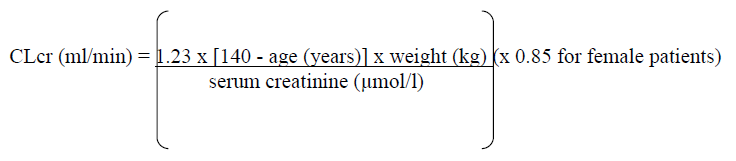
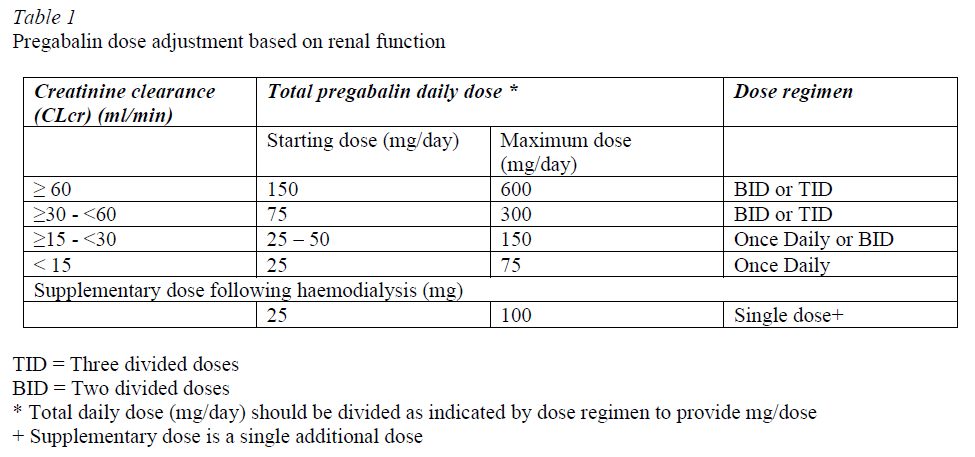
Pregabalin is eliminated from the systemic circulation primarily by renal excretion as unchanged drug. As pregabalin clearance is directly proportional to creatinine clearance (see section 5.2 – _please refer to the Product Insert/Patient Information Leaflet published on HSA for the full drug information_), dose reduction in patients with compromised renal function must be individualised according to creatinine clearance (CLcr), as indicated in Table 1 determined using the following formula:
Pregabalin is removed effectively from plasma by haemodialysis (50% of drug in 4 hours). For patients receiving haemodialysis, the pregabalin daily dose should be adjusted based on renal function.
In addition to the daily dose, a supplementary dose should be given immediately following every 4-hour haemodialysis treatment (see Table 1).
_Patients with hepatic impairment_
No dose adjustment is required for patients with hepatic impairment (see section 5.2 – _please refer to the Product Insert/Patient Information Leaflet published on HSA for the full drug information_).
_Paediatric population_
The safety and efficacy of pregabalin in children below the age of 12 years and in adolescents (12–17 years of age) have not been established. No data are available.
_Elderly (over 65 years of age) population_
Elderly patients may require a dose reduction of pregabalin due to a decreased renal function (see patients with renal impairment).
Method of administration
Pregabalin may be taken with or without food.
Pregabalin is for oral use only.
- Route Of Administration
- ORAL
- Indication Info
- **4.1 Therapeutic indications**
Neuropathic pain
Pregabalin is indicated for the treatment of neuropathic pain which includes diabetic peripheral neuropathy and post-herpetic neuralgia in adults.
Epilepsy
Pregabalin is indicated as adjunctive therapy in adults with partial seizures with or without secondary generalisation.
Generalised Anxiety Disorder
Pregabalin is indicated for the treatment of Generalised Anxiety Disorder (GAD) in adults.
Fibromyalgia
Pregabalin is indicated for the management of fibromyalgia.
- Contraindications
- **4.3 Contraindications**
Hypersensitivity to the active substance or to any of the excipients listed in section 6.1 – _please refer to the Product Insert/Patient Information Leaflet published on HSA for the full drug information_.
- Atc Code
- N03AX16
- Atc Item Name
- xn 03 ax 16
- Pharma Manufacturer Name
- LOTUS INTERNATIONAL PTE. LTD.
- Company Detail Path
- /organization/lotus-international-pte-ltd

